Koi at the Goldfish Market: The Pond Fish Sold Beside the Goldfish
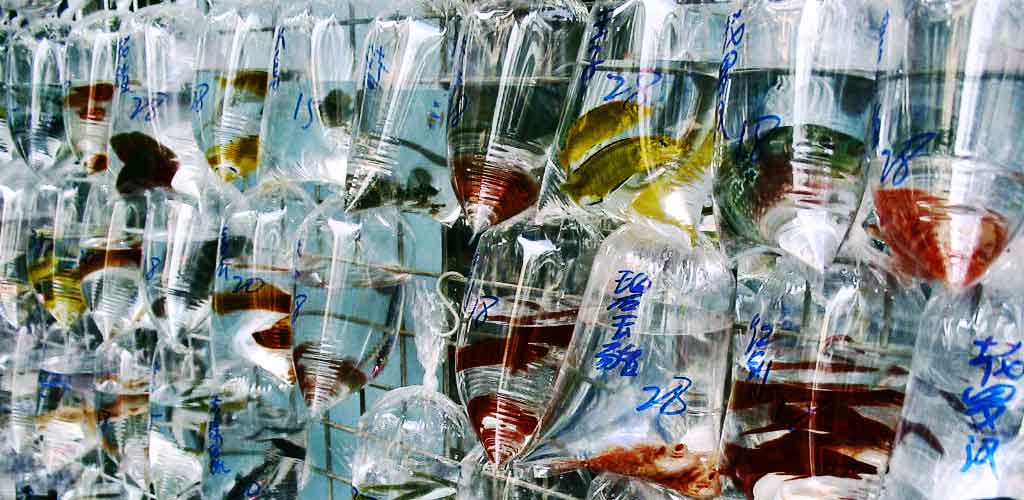
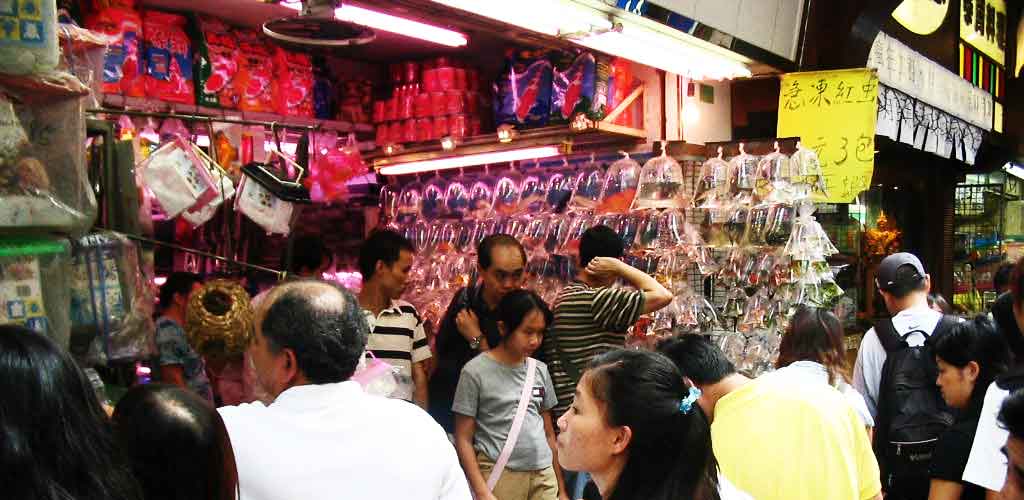
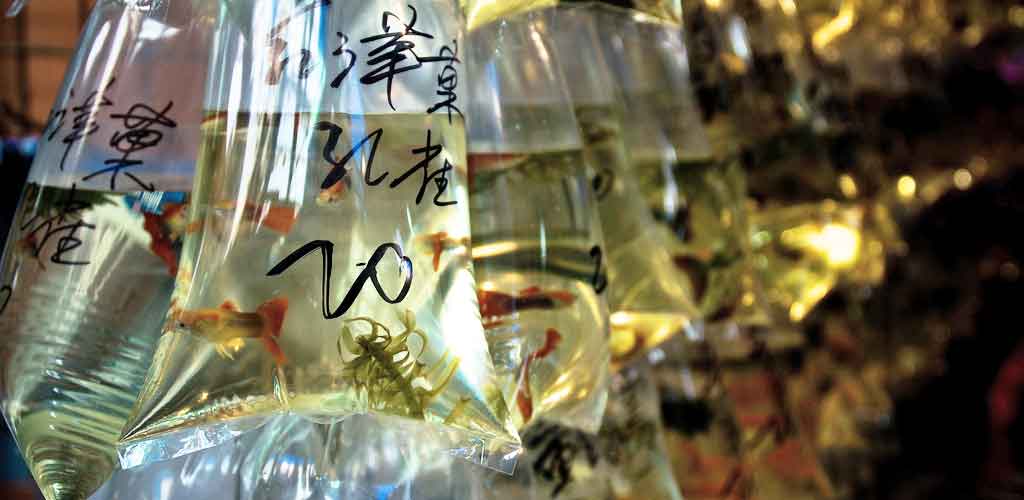
On the racks of Tung Choi Street, among the bowls of goldfish, there are usually a few much bigger fish in bags of their own — deep-bodied, silvery or mottled orange and white, with two little barbels at the corners of the mouth. Those are koi, and the first thing to get straight about them is that they are not goldfish. They are carp. The second thing is size: a koi does not stop where a goldfish stops.
🐟 Short answer
Koi are domesticated ornamental varieties of the carp Cyprinus rubrofuscus — a different species from the goldfish (Carassius auratus). Most koi average about 90 cm (about 3 feet) long when fully grown. That makes them pond fish, not tank fish, and it makes them an animal you should never turn loose into a Hong Kong pond or stream.
Koi are not goldfish
The goldfish is a small, domesticated member of the carp family, kept in tanks and bowls. The koi is a different animal altogether: a large, long-lived carp bred for colour and pattern and kept in outdoor ponds. The two share a family, not a species, and they are never tank mates.
On the naming, this is worth being precise, because two scientific names are in circulation. The USGS Nonindigenous Aquatic Species profile states plainly that koi are a domesticated ornamental carp taxa and that they are “ornamental varieties of domesticated carp that are often erroneously identified as European Carp (C. carpio)”; it follows Kottelat and Freyhof (2007) in placing them under Cyprinus rubrofuscus. Older works and some databases still file koi under their synonym Cyprinus carpio. Use the modern name, and read the older one as the same fish.
Where koi meet goldfish in the market is on the rack, not in the water. This site’s own species and care guide records that a visitor guide to the street describes the trade in shorthand as “all kind of goldfish varieties (including koi) and tropical fishes”. That phrase is the trade bundling everything orange and finned under one sign — it is not a statement that koi are a goldfish variety. They are not.
One cultural note, kept brief. In the Chinese feng-shui tradition koi are the pond fish — the outdoor fish of prosperity and perseverance — while the goldfish is the indoor tank fish. For that side of the trade, see our feng shui guide to goldfish; here the point is only that the two fish are kept in two different places by design.
Why a koi will not fit the tank you had in mind
It grows to about arm’s length. Britannica puts a fully grown koi at about 90 cm (about 36 inches) and around 16 kg; the Smithsonian’s National Zoo states that koi can grow up to 3 feet (90 cm). For contrast, the wild stock of the species C. rubrofuscus is recorded by FishBase at a maximum of 28.0 cm standard length. The wild fish runs smaller than the ornamental fish sold as koi — so when you read a number for koi, the one that matters to a shopper is the big one, because that is what arrives in a few years’ time.
Welfare guidance treats a fish this size as unsuitable for a home tank. The RSPCA’s aquarium guidance says that only a tank larger than 45 × 30 × 30 cm (about 40 litres) should be bought at all and that bowls and jars are unsuitable; it then adds that “some adult fish grow very large, making them unsuitable as pets”. A fish that ends up around 90 cm is not a bowl fish and is not a home-tank fish, and it should not be bought on the strength of how it looks in a bag.
A goldfish tank is not a koi home. This site’s care guide budgets 50 litres per goldfish — the regime behind every domestic goldfish tank. A koi is a different order of animal. We print no litre figure for koi here, because no authority (the RSPCA, FishBase or an equivalent) publishes a koi-specific minimum volume, and inventing one would be worse than leaving it out. The honest rule is to decide the space before you fall for the fish: koi belong in a pond, and the pond has to exist first.
| Goldfish | Koi | |
|---|---|---|
| Species | Carassius auratus | Cyprinus rubrofuscus (older works: C. carpio) |
| Adult size | Small — a few tens of centimetres at most in a tank | About 90 cm (about 3 ft) fully grown; wild stock max 28.0 cm SL |
| Where it belongs | Indoor tank or bowl (bowls discouraged); 50 litres budgeted per fish | Outdoor pond — no authority publishes a tank minimum, because it is not a tank fish |
| Tradition | The indoor feng-shui fish | The pond fish of the tradition |
| Status | Domesticated aquarium fish | Domesticated ornamental carp; recorded as an exotic/nonindigenous species outside its native range |
Sizes are the fully grown figures from Britannica and the Smithsonian’s National Zoo (ornamental koi) and FishBase (wild C. rubrofuscus). No authority publishes a formal minimum pond or tank volume for koi, so this page gives none.
If the fish is going to live outdoors, the pond has its own winter routine. The RSPCA’s winter guidance notes that as the water cools, pond fish slow down and seek shelter in the deeper or more sheltered parts of the pond, and it recommends testing pH, ammonia, nitrite and nitrate and doing partial water changes of about 10–20% every two weeks, even in winter. Feeding a slowing fish as if it were summer is the common mistake.
The koi trade on this street
Tung Choi Street is a general aquarium street, not a goldfish-only one: press coverage describes it as offering “the widest range of exotic aquatic creatures in town”, alongside small mammals and reptiles. Koi sit inside that range. The street has long been home to dedicated Japanese-carp specialists as well as general shops — press reporting has named koi traders here whose business extended to pond work and supplying fish to hotels, not just the sale of a bagged fish.
Two cautions come with that. First, that coverage is old and undated: shop names, numbers and owners change on a street like this, so treat “a koi specialist is here” as a description of the trade rather than of this week’s stock. Second, the price you will actually see is written on the bag by the shop that is selling it, and this page prints no koi price at all — see the FAQ below for why.
If you cannot keep it — do not release it
Koi are an introduced species outside their native range, which FishBase places in Laos, Vietnam and China (Amur to Red River drainages); the USGS records them as exotic/nonindigenous where they have been brought in. In Hong Kong the government's own position is clear, and it is worth quoting exactly.
The Agriculture, Fisheries and Conservation Department (AFCD) lists “aquarium pet breeding” among the intentional pathways by which alien species arrive in Hong Kong. And the government’s stated position on letting them go is that “release of animals into the wild not only affects the equilibrium of local ecosystems but is also detrimental to animal welfare and may spread disease” — and that the practice is discouraged by the AFCD. The RSPCA says the same from the welfare side: it does not recommend releasing fish into outdoor ponds, because they can damage wildlife and spread disease.
So the rule for a koi you can no longer keep is the one for any pet: do not put it in a park pond, a stream or the harbour. Return it to the shop if they will take it, rehome it to a keeper with a pond, or ask a koi or pond club — but do not release it.
Frequently asked questions
Are koi just big goldfish?
No. A goldfish is Carassius auratus; a koi is a domesticated ornamental carp, Cyprinus rubrofuscus (older works call it C. carpio). They are different species, they grow to very different sizes, and they belong in different places — the goldfish in a tank, the koi in a pond.
Can I keep a koi in a tank at home?
Plan for a pond, not a tank. Fully grown koi average about 90 cm (about 3 feet), and the RSPCA’s guidance treats adult fish that grow very large as unsuitable as pets. No authority publishes a koi-specific minimum volume, so we print no litre figure: decide the space before you buy the fish, not after.
How much is a koi at the Goldfish Market?
We print no price, because there is no verified Hong Kong price to print. Koi are priced bag by bag, shop by shop, and the street has no management body that issues a list. The “HK$5,000 koi” figure that circulates online traces to unattributed guide sites — the same figure this site’s care guide already flags as unsourced — so treat any number you are quoted as that seller’s asking price, not a market rate.
Can I release a koi into a park pond or the harbour?
No. Koi are an introduced species, and the Hong Kong government states that releasing animals affects the equilibrium of local ecosystems, is detrimental to animal welfare and may spread disease; the AFCD discourages it. Return the fish to the shop, rehome it to a pond keeper, or ask a club — do not release it.
Sources and how to check them
- USGS Nonindigenous Aquatic Species, Koi (Cyprinus rubrofuscus) species profile — koi as domesticated ornamental carp taxa, the identification as C. rubrofuscus (Kottelat and Freyhof 2007), the “often erroneously identified as European Carp (C. carpio)” wording, the taxonomy history and the disease note: nas.er.usgs.gov.
- FishBase, Cyprinus rubrofuscus Lacepède, 1803 — native range (Laos, Vietnam, China; Amur to Red River drainages), maximum length 28.0 cm SL, freshwater/brackish, IUCN Least Concern (assessed 20 March 2020) and CITES Not Evaluated: fishbase.se.
- Encyclopædia Britannica, koi — koi as ornamental carp varieties kept in ponds, “most koi average about 90 cm (about 36 inches) long and weigh about 16 kg when fully grown”, and the C. carpio / C. rubrofuscus classification history: britannica.com.
- Smithsonian’s National Zoo and Conservation Biology Institute, Japanese koi — “koi can grow up to 3 feet (90 centimeter) in length” and never release animals kept as pets into the wild: nationalzoo.si.edu.
- RSPCA, choosing an aquarium — only get a tank larger than 45 × 30 × 30 cm (about 40 litres), bowls and jars unsuitable, “some adult fish grow very large, making them unsuitable as pets”, and the warning against releasing fish into outdoor ponds: rspca.org.uk.
- RSPCA, caring for pet fish in winter — pond fish seeking shelter in deeper or sheltered water as metabolism slows, testing pH/ammonia/nitrite/nitrate, and partial water changes of about 10–20% every two weeks even in winter: rspca.org.uk.
- Agriculture, Fisheries and Conservation Department, Invasive Alien Species — “aquarium pet breeding” named among the intentional pathways that bring alien species into Hong Kong: afcd.gov.hk.
- HKSAR Government, “LCQ22: Prevention of alien species’ invasion of Hong Kong’s natural environment”, Legislative Council answer of 11 November 2015 — “release of animals into the wild not only affects the equilibrium of local ecosystems but is also detrimental to animal welfare and may spread disease… discouraged by the AFCD”: info.gov.hk.
- South China Morning Post, “Tung Choi Street” — the street offers “the widest range of exotic aquatic creatures in town”, alongside other small mammals and reptiles; used here as attributed press description, not as evidence of current stock: scmp.com.
Where a point is weaker than the rest, this page says so in the text. The presence of dedicated koi specialists on the street rests on old, undated press coverage, so it is written as a description of the trade and not of current stock, and no shop is named or price quoted on that basis. Everything load-bearing — that koi are a carp species and not a goldfish, their fully grown size, the goldfish’s separate species and tank regime, the release position, and the winter pond routine — is sourced to a government body, a national museum, FishBase, Britannica or the RSPCA.