Goldfish Market Species and Care: What's Actually on Sale, and How to Keep It Alive
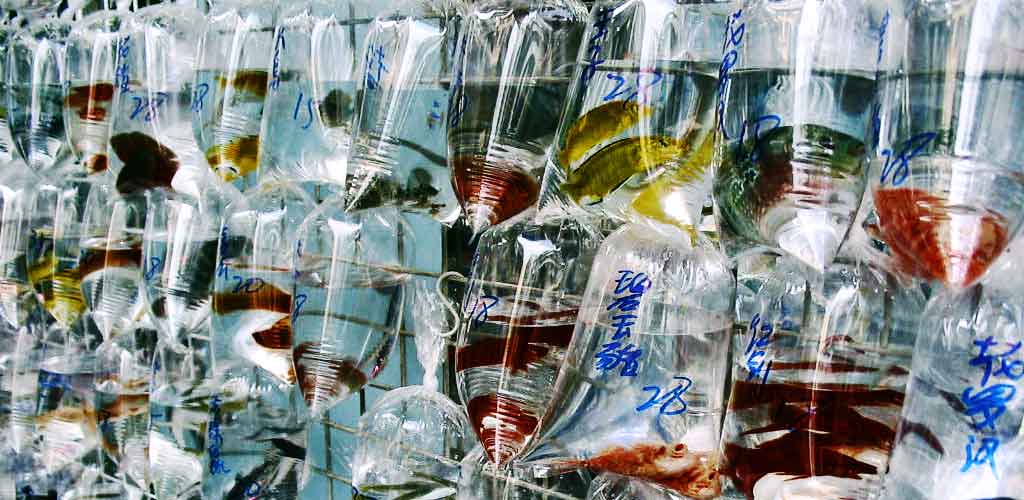
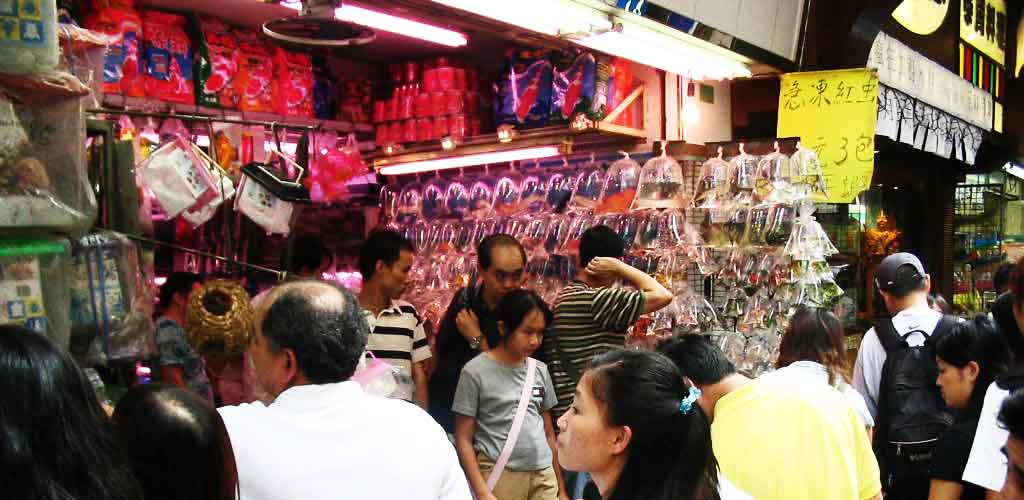
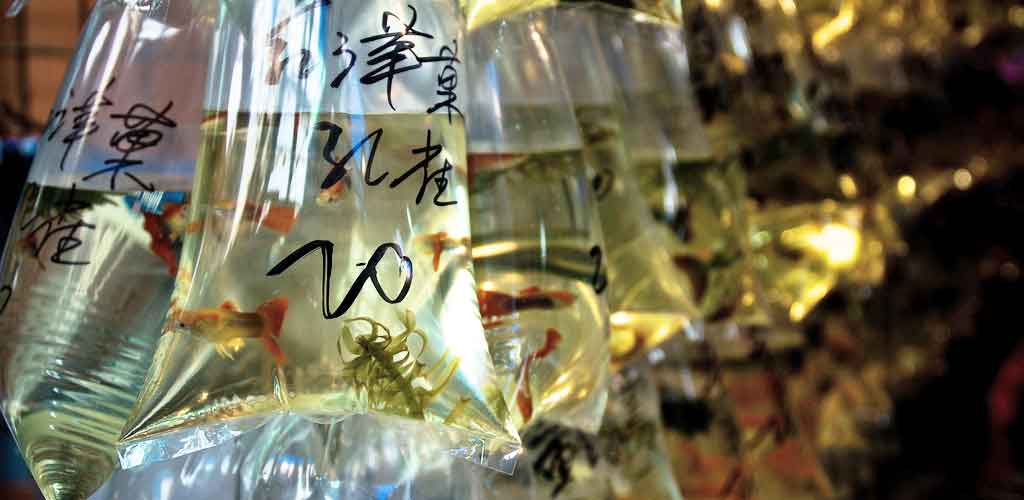
Tung Choi Street's Goldfish Market is the strangest aquarium you will ever walk through. Hundreds of plastic bags of live fish hang on racks outside the shopfronts, each with a price written on it in marker pen, and behind them the shop sells the tank, the filter and the food you are going to need within the hour. It is not a display of a handful of ornamental varieties either: the most recent survey of this exact pavement counted 540 species of freshwater fish on sale along it.
So the useful questions are not "which fish is prettiest". They are four harder ones — what is actually on the racks, what the fish costs once you have also bought the tank, whether you can keep it alive at home, and whether you can get it home at all. This page answers all four, and says where every number comes from.
🐟 Short answer
The Goldfish Market is a free public street of shopfronts, not a ticketed attraction, and the fish are the cheap part: bags of common goldfish run from roughly HK$10 to HK$50. The tank, the filter and the first year of running them are what cost money. A goldfish needs at least 50 litres of water and a filter — not a bowl — and a new tank needs four to six weeks to cycle before any fish goes in. Finally, settle how you are getting home before you pay: Hong Kong's MTR by-laws prohibit animals on the network unless MTR permits otherwise, and MTR's own permissions cover dogs and cats, not fish, so a bagged fish cannot ride the train.
What the Goldfish Market actually sells
The market is a section of Tung Choi Street in Mong Kok, between Mong Kok Road and Nullah Road — about 300 metres of shopfronts on both sides, free to walk, and with no market-wide opening schedule because each shop is its own business. The Hong Kong Tourism Board's own listing describes a 300-metre stretch "lined with dozens of stores with a variety of aquatic creatures and other animals"; the market description adds pet products and pets, and press coverage of the street in April 2023 names tortoises, frogs, lizards, cats, dogs and rabbits among what is on sale there.
The hard number on the fish side comes from a peer-reviewed study published in Oryx in June 2026, whose authors surveyed Hong Kong's primary aquarium shop district — this street — weekly for three months. They recorded 540 freshwater fish species in 73 families. Two of their results matter to a buyer. First, how often a species turned up on the racks was "largely price-driven", with minimum retail price the strongest predictor of how often it appeared — in plain terms, the cheap fish dominate the walls, which is why you see bag after bag of the same few varieties. Second, 86 of those species (16%) were potentially undescribed, and those unknowns clustered at the expensive end of the market.
| On the racks | What it is, and what to know |
|---|---|
| Goldfish (Carassius auratus) | The market's namesake and its volume seller, bagged and price-marked. The tourism board calls the goldfish "a symbol of good luck", which is why it is here in these numbers. Common single-tail types are the cheap ones; the fancy short-bodied types cost more and are harder to keep. |
| Koi | Displayed alongside the goldfish varieties. A visitor guide to the street (its current version dates from May 2019, and the page has been archived since 2015) describes "all kind of goldfish varieties (including koi) and tropical fishes" on the racks — and koi grow far larger than goldfish, so the species you fall for may not suit the tank you had in mind. |
| Tropical freshwater fish | The bulk of the trade by species count. The Oryx survey's 540 freshwater species covers the tropical trade on this street; note that tropical fish need warmer water than goldfish and are not tank mates for them. |
| Rare and unusual freshwater species | The expensive end. The same survey found the potentially undescribed species concentrated there, and that rarity and price reinforce each other. This is the section where a fish costs more than the whole tank set-up. |
| Turtles and tortoises | Sold on the same street, and named in the market's press coverage — tortoises appear in the April 2023 list of animals on sale there. They need very different housing from fish — assume a tank, a basking lamp and decades of commitment. |
| Frogs and lizards | Also part of the street's pet-shop stock, per 2023 press coverage of the market. These are specialist animals; a shop that sells them is not a shop that will tell you how to house them in a small flat. |
| Cats, dogs and rabbits | Some shops on this street are general pet shops rather than aquariums, and the same 2023 coverage names cats, dogs and rabbits among what is on sale. Worth knowing before you promise a child "the fish shop". |
| Tanks and aquariums | Ready-made and custom-built tanks are a core part of the trade, and the reason the street is a destination for local keepers rather than only for visitors. |
| Pumps, filters, gravel, rocks, driftwood, decorations and fish food | Everything below the waterline. The same visitor guide lists "custom aquariums … pumps, rocks, driftwood, corals, gravel, filters, decorations and plants" among the stock. Buy the life-support equipment the same day as the fish, not after. |
| Aquatic plants | Sold by name and mostly bagged: Water Wisteria, Java Moss, Amazon sword, Java Fern and Green Tiger Lotus are among the species the same visitor guide identifies. Plants from a shop are safe to add; plants from a wild pond are not. |
These ten rows are the categories you will see on the shopfronts — not a sales ranking. We found none published, and the Oryx census is the only species-level count that exists for this street. Prices are inked on the bags shop by shop, so there is no market-wide rate to check against.
What the fish cost — and what the tank costs
The fish itself is the small part of the bill. Visitor guides put a bag of common goldfish at roughly HK$30–50 (thingstodoinhk.com) or from HK$10 (shortstayguide.com), and a TripAdvisor reviewer recorded paying HK$20 for three fish in June 2025. Those are guide-site and user-reported figures rather than a tariff: the market has no management body to publish a price list, and neither the tourism board nor the government lists one. But those figures do agree on the order of magnitude, and it is low — a bag of common goldfish costs less than a bowl of noodles.
What costs money is everything the fish needs in order to live. The only Hong Kong-specific budget we could find that itemises a first freshwater tank is a 2026 pet-cost guide. Read the table below with the caveat attached to it: every row except the tank is that single guide's estimate, the guide publishes no methodology, and the same site prints the same list in US dollars — so plan with these figures rather than treating them as a tariff. The tank line has a second Hong Kong source, noted in the row.
| Item | Stated cost |
|---|---|
| Tank, 75–115 litres (the guide's "recommended for beginners" size) | HK$600–1,500 — and a second Hong Kong source, retail complete sets: about HK$430–1,880 |
| Filter, heater and lighting | HK$500–1,200 |
| Substrate, decorations and plants | HK$250–600 |
| Water testing kit | HK$100–250 |
| Fish stock (community species) | HK$150–600 |
| First-year total, freshwater community tank | HK$2,500–7,000 |
| Ongoing monthly (food, conditioner, electricity, replacement stock) | HK$150–400 |
Every row in this table except the tank is one guide's estimate. That guide publishes no methodology, and the same site prints the same list in US dollars — so the Hong Kong column is a localisation of a template, not a price survey of this street. The tank line is the one row with a second Hong Kong source: 2026 retail listings for complete beginner sets run GEX Aqua Clear Set 300 HK$430, GEX Aqua Clear Set 500 HK$695, GEX Slim Aqua Set 600S HK$755, NEWA More-20 HK$980, NEWA More-30 HK$1,200, AA Basic 130 set HK$1,480 and NEWA More 30R HK$1,880 — the same order of magnitude as the guide's HK$600–1,500. No second Hong Kong source exists for the filter, substrate, test-kit, fish-stock or monthly rows, and none of these figures is a price on this street.
✅ Where these numbers come from
Here is the provenance, figure by figure. The species census is a peer-reviewed paper (Oryx, published 10 June 2026). The care and water figures are RSPCA goldfish guidance (Australia, updated 1 May 2024). The packing method is FAO and university-extension practice, and the MTR rule is the by-law itself. The prices are weaker and are labelled as such in the text: HK$30–50 and HK$10 come from two visitor-guide sites, and the tank budget is from one 2026 Hong Kong pet-cost guide (trustmypets.com), whose tank row we cross-checked against Hong Kong retail set listings (HK$430–1,880). That guide's itemised parts fall in the same order of magnitude as its stated total, but it states no methodology — treat it as an estimate, not a quotation, and expect this street to beat the guide's retail figures.
We could not price the top of the market, so this page prints no ceiling. The "HK$500+ rare goldfish" and "HK$5,000 koi" figures that circulate online trace to unattributed guide sites, and the Oryx study's own per-species price tables sit behind the article body. What the study does establish is that the expensive end is real, and that it is where the little-known species cluster. Treat any large number quoted to you at the market as that shop's asking price, not a market rate.
Before you buy: the tank, the filter, and four to six weeks of waiting
Welfare guidance is blunt about the goldfish bowl: a bowl is not a home. The RSPCA's goldfish guidance (Australia, updated May 2024) gives a minimum tank volume of 50 litres, with a tank at least four times the fish's adult body length long, twice as wide and three times as high — and the same guidance adds that the more fish you keep, the larger the tank needs to be, so we would budget 50 litres per fish: two goldfish means 100 litres, not 50. Traditional bowls "are too small for goldfish and should be avoided". Depth matters as well as volume: oxygen enters at the surface, so a long, low tank beats a tall, narrow one of the same litre count.
A filter is not optional either. Goldfish are described as heavy feeders and high waste producers, and the filter is where the bacteria live that turn their ammonia into something far less toxic. Choose one with an adjustable flow, because fancy goldfish swim badly in a strong current, and add an air stone if the filter does not stir the surface.
The step almost every first-time buyer skips is the waiting. A brand-new tank has no bacteria in it to process fish waste, so the fish you add on day one is swimming in its own poison. The RSPCA's testing schedule is to check ammonia and nitrite every two to three days for the first six weeks while the nitrogen cycle establishes, and the same guidance puts the cycle itself at four to six weeks. RSPCA UK's advice is fishless cycling: only add fish once ammonia and nitrite have spiked and then returned to zero. Waiting the cycle out before you stock is the conclusion we draw from those two schedules rather than a phrase either organisation prints. The target water parameters for goldfish are ammonia below 0.1 ppm, nitrite below 0.2 ppm, nitrate below 50 ppm, pH 6.5–7.5 and 20–24°C.
Give the fish something to hide behind, too. Goldfish are prey animals, and plant cover of roughly half the tank, with open water between, keeps them calmer and more active. Live plants should come from an aquarium shop — never a garden pond or the wild, which brings parasites with them — and any ornament should be free of sharp or rough edges.
⚠️ The three things that kill a new goldfish
Overfeeding, an uncycled tank, and a bowl. All three are easy to avoid and all three are extremely common. Feed less than you want to; let a new tank cycle for four to six weeks before the first fish; and if the tank is under 50 litres, buy a bigger one instead of the fish.
Feeding, water and the care that actually matters
Overfeeding is named as the most common problem with goldfish, and it kills indirectly: uneaten food rots, the rot feeds ammonia, and the ammonia kills the fish. Feed once a day, and only as much as the fish clears in under two minutes. If you keep more than one, feed in two separate spots so the slower fish eats.
- Fancy goldfish need sinking food. Short-bodied varieties should get sinking pellets rather than flake or floating pellets, so they are not gulping air at the surface — swallowed air causes buoyancy problems. Flake and granules are fine for the slim, single-tail types.
- Variety, but not mammalian fat. Goldfish flake and pellets as the staple, supplemented with frozen brine shrimp, daphnia or scalded peas. Soak freeze-dried food before it goes in. Beef heart, meat and offal are poorly digested and should not be fed to goldfish at all.
- Cold slows them down. Below about 8°C a goldfish's metabolism drops and it cannot digest a full feed, so feed lightly or not at all.
- Change water every week. Replace 10–25% of the tank water weekly and siphon the gravel while you do it. Rinse the filter media in a bucket of tank water — never under the tap, because the chlorine kills the bacteria you spent four to six weeks growing.
- Put the light on a timer. Up to 10 hours of light a day and at least 8 hours of darkness, away from direct sunlight, or you will grow algae instead of fish.
- Companions, with rules. Goldfish are social and do better in twos than alone. Tank mates must be bigger than the goldfish's mouth; white cloud mountain minnows, danios and gold medaka suit smaller tanks. Do not house long-finned goldfish with fin-nippers such as tiger barbs, and keep the Celestial variety with its own kind only, because it cannot compete for food.
Getting it home alive
Every bag on that street is a life-support system with a clock on it. Shops pack fish the way the trade packs them everywhere: a polythene bag filled roughly one-third with water and two-thirds with pure oxygen (that is FAO's training-manual wording; the FAO review's own worked example is 20 litres of water to 30 litres of oxygen in a 50-litre bag, about 40:60), twisted above the water line and sealed — the method set out in FAO fisheries practice and in university-extension guidance for transporting fish in bags. The oxygen head space is the point, because a bag charged with air holds a fraction of the reserve. It is also why a sealed bag behaves like a small greenhouse on a hot pavement.
So the journey home matters more than the purchase:
- Buy last, then go straight home. Do not buy a bag of fish and then walk the other markets. A properly packed bag is good for hours rather than days, and every hour in it adds waste to the water.
- Keep it cool, dark and upright. Temperature is the variable that stresses fish fastest, so keep the bag out of direct sun, off hot pavement and out of a parked car. Trade practice for a longer journey is a double bag and an insulated box with a cool pack — cool packs beside the bags, never ice in contact with them.
- Float the bag before you release the fish. At home, float the sealed bag in the tank for 15–30 minutes so the water temperatures match (the care sheets put the float at 15–20 minutes and allow up to an hour), then add a little tank water over the next 20–30 minutes and net the fish out. This sequence is ordinary aquarium-trade practice rather than one authority's rule, and the trade's own point is that unpacking matters as much as packing. Do not pour the bag water into the tank; it carries the ammonia the fish has produced on the way.
- Do not release it anywhere. Hong Kong's Agriculture, Fisheries and Conservation Department lists "aquarium pet breeding" among the pathways that bring alien species into Hong Kong, and the government's stated position on releasing animals is that the practice affects "the equilibrium of local ecosystems", is "detrimental to animal welfare" and may spread disease — the department discourages it (an answer given in the Legislative Council on 11 November 2015, repeated in the department's restocking advice of 6 June 2025). If you cannot keep the fish, give it to another keeper or back to a shop.
⚠️ You cannot take a bag of fish on the MTR
The MTR's by-laws are explicit. By-law 28, "Animals prohibited on railway premises", says that no person shall — unless the Corporation in its sole discretion allows or permits — bring any animal or other livestock into or upon any part of the railway premises, the proviso being that the restriction does not apply to a guide dog accompanying a blind person. The penalty listed for that by-law is HK$2,000. That permission clause is not a dead letter: MTR grants exceptions at its own discretion, and it does so today for dogs and cats on the Light Rail (Cat/Dog Carrying Pass, HK$99 a month, weekends and public holidays, the animal fully enclosed in a carrier). It has also granted one for pet dogs on a single day — the Woof Pass for the SPCA Dogathon on 1 March 2026. Neither permission covers a fish. By the by-law's wording a bagged fish is an animal, and we found no exemption that covers one. The MTR's own passenger safety booklet lists "Animals, birds, or livestock (except guide dogs)" among the things not to bring onto the network. Plan on walking or taking a taxi, and decide that before you pay — buying at the market and finding out at the turnstile is how a fish dies in a plastic bag.
Should you actually buy one?
The market is a wonderful place to look and a serious place to buy, and the two are worth separating before you are standing at the rack.
Buy, if…
- You already have a running tank, or you live in Hong Kong and can wait four to six weeks while a new one cycles.
- You have decided where the tank goes, and it holds 50 litres per goldfish — 100 litres for a pair.
- You can carry the bag home without a train ride, and you are heading straight home afterwards.
Do not buy, if…
- Your home is a hotel room, a hostel or a short let. Fish do not do short lets, and the market is not a place to leave a pet behind.
- Your plan involves a bowl. At least 50 litres and a filter is the floor, not the ideal.
- You were going to carry it on the MTR — see the by-law above.
- You are flying home next week. A live fish is not a souvenir you can pack, and moving one across a border is an export question with paperwork attached.
If what you came for is the tradition rather than the animal — the goldfish as a prosperity symbol, the tank as a feng shui arrangement — you can take that home without the mortality risk: ceramic fish, tank ornaments, fish food and guidebooks all travel in a suitcase. See what to buy at the market for the symbols and the shopping, and our feng shui guide to goldfish for what the fish is supposed to mean.
Before you go: the practical bits
- Where it is: Tung Choi Street (North), between Mong Kok Road and Nullah Road in Mong Kok — about 300 metres, free to walk, no ticket.
- When to go: most shops open between 10:00 and 11:00 and trade until about 22:00, but there is no market-wide schedule — each shop sets its own, so an afternoon gives you the best odds of everything being open. Our opening hours page has the detail.
- How to get there: MTR Prince Edward Station, Exit B2 is the approach most guides give; the tourism board itself names no exit. See how to get to Tung Choi Street.
- Doing the markets as a walk: the Ladies' Market runs along the southern stretch of the same street, and the Flower Market and the Yuen Po Street Bird Garden are a short walk north. Our four markets in one walk page sets out the order and the timing, and there is a longer self-guided Mong Kok walking tour if you want a half day.
- Photographing it: the tourism board's one published rule is no flash, and some shops ban photography outright — read the photography guide before you raise a camera.
- The rest of the neighbourhood: our guides to the Flower Market, the Ladies' Market, the Bird Garden and Sneaker Street.
Sources and how to check them
- Oryx, "Species diversity, pricing trends and conservation concerns in a major ornamental fish hub", Cambridge University Press, published online 10 June 2026 — the 540-species census, the price-driven occurrence finding and the 16% undescribed figure: cambridge.org.
- Hong Kong Tourism Board, Goldfish Market listing — the address, the 300-metre figure, "dozens of stores", the good-luck symbolism and the no-flash rule: discoverhongkong.com.
- HKSAR Government, "Hong Kong Fun in 18 Districts" — the market's address and the street boundaries: gohk.gov.hk.
- RSPCA (Australia), "How should I care for my goldfish?", updated 1 May 2024 — tank volume and dimensions, water parameters, the first-six-weeks testing schedule, filtration, feeding and the purchasing checklist: kb.rspca.org.au.
- RSPCA (Australia), "Can I keep my goldfish with other fish?" — the tank-mate rules (the mouth-size rule, white cloud mountain minnows, danios, gold medaka, fin-nipping barbs, and the Celestial kept with its own variety): kb.rspca.org.au.
- RSPCA (Australia), "Why is water quality important when setting up a fish aquarium?" — the nitrogen cycle "usually takes 4 to 6 weeks"; and RSPCA UK's fish environment guidance — fishless cycling, adding fish only after an ammonia and nitrite spike has returned to zero: kb.rspca.org.au; rspca.org.uk.
- Hong Kong first-year cost figures — trustmypets.com, "New Pet Budget 2026: First Year Costs in Hong Kong" (the itemised table: one source, no published methodology, and the same list is published in US dollars), plus the tank row's second source, Hong Kong retail listings for complete sets: trustmypets.com; price.com.hk aggregator offers; greenflow.hk.
- FAO, The transport of live fish: a review — polythene bags, the water-and-oxygen fill and the seal (its worked example is 20 litres of water to 30 litres of oxygen in a 50-litre bag, about 40:60): fao.org; and FAO's training manual for the "one-third water, two-thirds oxygen" fill: fao.org.
- University of Missouri Extension, "Transportation of Fish in Bags" — the ~75% oxygen fill, double bagging and temperature packs: extension.missouri.edu.
- Aquarium-trade guidance on unpacking and acclimation, read 2026-10-13 — the 15–30 minute float and the gradual mixing of tank water, treated here as ordinary trade practice rather than one authority's rule: Petco's aquatic-life acclimation care sheet (petco.com), seacaveinc.com (seacaveinc.com) and fishtankcalculator.com (fishtankcalculator.com).
- MTR by-laws, by-law 28 — including the "unless the Corporation in its sole discretion allows or permits" clause and the Schedule 2 penalty of HK$2,000: mtr.com.hk; the same text on MTR's High Speed Rail site: highspeed.mtr.com.hk; MTR's discretionary pet-carrying permissions (Light Rail Cat/Dog Carrying Pass; and the one-day Woof Pass for the SPCA Dogathon of 1 March 2026): mtr.com.hk pet carrying and SPCA/MTR Woof Pass terms; and Hong Kong Free Press, 11 March 2025, on the HK$2,000 fine: hongkongfp.com.
- Agriculture, Fisheries and Conservation Department, Invasive Alien Species — "aquarium pet breeding" named among the pathways that bring alien species into Hong Kong: afcd.gov.hk.
- HKSAR Government, "LCQ22: Prevention of alien species' invasion of Hong Kong's natural environment", Legislative Council answer of 11 November 2015 (repeated in the Agriculture, Fisheries and Conservation Department's restocking release of 6 June 2025) — the position against releasing animals: info.gov.hk.
- South China Morning Post, 6 April 2023 — shops banning photography, and the market's wider pet stock (cats, dogs, rabbits, tortoises, frogs, lizards): scmp.com.
- NextStopHongKong, Goldfish Market guide — its current version dates from May 2019, and the page has been archived since 2015 — the "including koi" and "tropical fishes" stock description, and the aquatic plant species named above: nextstophongkong.com.
Five items above rest on single, weaker sources and are labelled in the text as such: the HK$30–50 bag price (thingstodoinhk.com), the HK$10 figure (shortstayguide.com), the HK$20-for-three report (a TripAdvisor visitor review of June 2025), the first-year tank budget (trustmypets.com, "New Pet Budget 2026: First Year Costs in Hong Kong" — one guide, no methodology, and only its tank row has a second Hong Kong source), and the float-and-mix sequence, which is ordinary aquarium-trade practice rather than an authority. The price figures came from this site's research pack of 2026-10-06; the authority sources listed above were re-read on 2026-10-13, when this page's citations and figures were checked and corrected. Prices on this street change with the shop, the season and the fish, so treat every figure here as a check, not a quotation.