Cichlids and the Luohan at the Goldfish Market: The Big, Hump-Headed Fish on the Racks
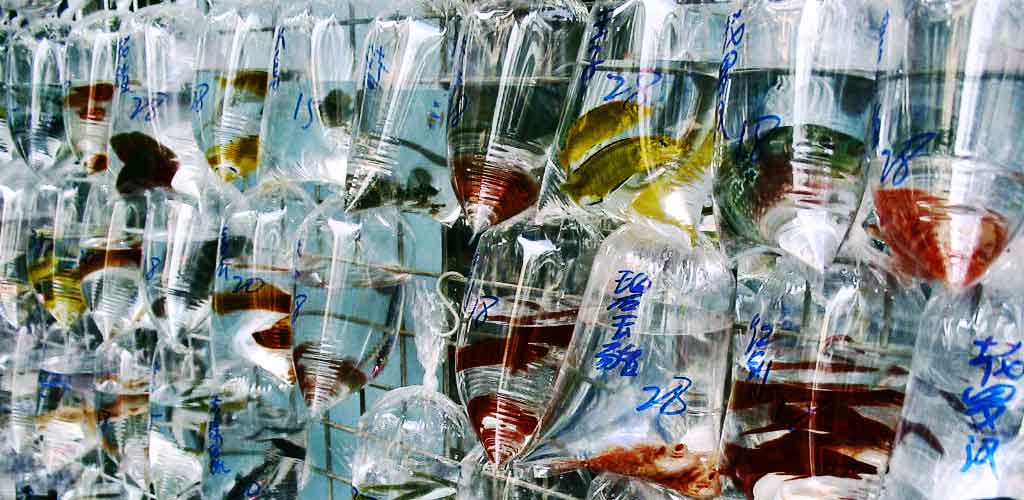
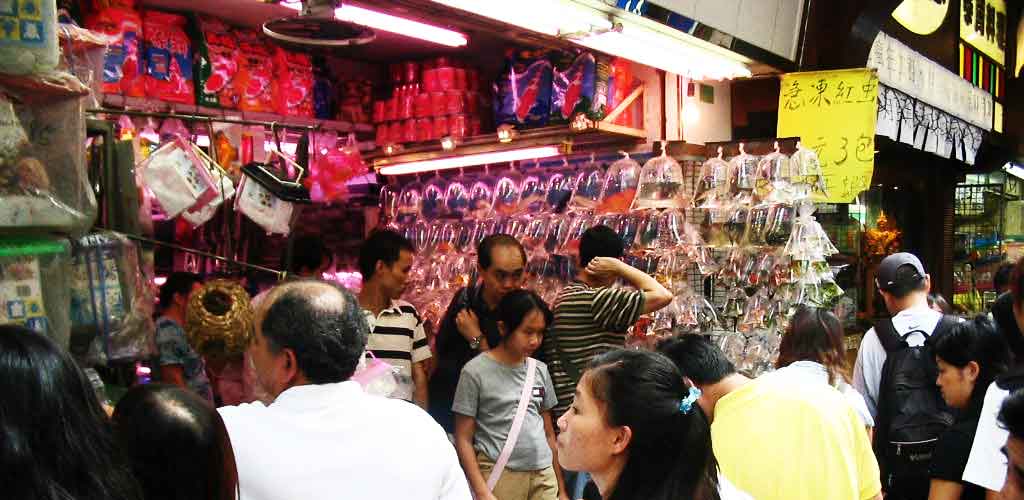
Tung Choi Street is called the Goldfish Market, and goldfish are what most visitors come to photograph. But the racks hold more than one family of fish, and the ones that stop people in their tracks — big, heavy-bodied, brightly coloured, with a lump on the forehead — are not goldfish at all. They are cichlids, and the largest and most recognisable of them is sold here as the luohan, better known in English as the flowerhorn.
That matters for two reasons. Cichlids are one of the most species-rich families in this market — third, in the only species-level survey ever done of this street — and some of the fish on sale under that name are man-made hybrids that have no scientific name at all. Here is what you are actually looking at, and what buying one would commit you to.
🐠 Short answer
It is not a goldfish. The big head-humped fish on the racks is a cichlid (family Cichlidae), a tropical family that needs warmer water than a goldfish. Cichlids are the third most species-rich family recorded on this street — after the armoured catfishes and the tetras — in the only species-level survey of the market ever published. And some of the fish you are looking at are man-made hybrids with no valid scientific name, the luohan among them.
What a cichlid actually is
The cichlids are a large family of freshwater fish, Cichlidae, found across Africa, Central and South America and parts of Asia. The ones that dominate the ornamental trade from Central America — and the stock behind the big head-humped fish on these racks — are the Amphilophus cichlids. Two wild species matter most to a buyer, because they are the fish the hybrids are built from and, in their own right, fish you will see bagged here.
The Midas cichlid, Amphilophus citrinellus (Günther, 1864), is native to the Atlantic slope of Nicaragua and Costa Rica — the San Juan River drainage, including Lakes Nicaragua, Managua, Masaya and Apoyo. Adults are mostly bright orange to orange-red. It reaches a maximum recorded standard length of about 24.4 cm, prefers water of 23–33 °C, and FishBase notes that mature males are larger, with longer fins and a distinct hump on their heads — the feature you are looking at on the rack. It is assessed as Least Concern by the IUCN.
The three spot cichlid, Amphilophus trimaculatus (Günther, 1867), comes from the Pacific slope, from Mexico down to El Salvador, and grows larger still — a maximum recorded standard length of about 36.5 cm for a male. It tolerates 21–30 °C and is also assessed as Least Concern. Both are listed as commercial aquarium species in FishBase, which is the plainest way of saying they are bred and sold as ornamentals rather than caught for the table.
| Fish | What it is | Adult size | Water | Status |
|---|---|---|---|---|
| Midas cichlid Amphilophus citrinellus |
Wild Central American cichlid; the species whose lineage the luohan comes from. Adults mostly bright orange to orange-red. | Up to ~24.4 cm SL; males larger, with a head hump | Tropical, 23–33 °C | IUCN Least Concern; CITES not evaluated; commercial aquarium species |
| Three spot cichlid Amphilophus trimaculatus |
Wild Central American cichlid, Pacific slope from Mexico to El Salvador; the species most often named as the hybrid's other parent. | Up to ~36.5 cm SL (male); ~25.0 cm TL (female) | Tropical, 21–30 °C | IUCN Least Concern; CITES not evaluated; commercial aquarium species |
| Luohan / flowerhorn | Not a wild species: a man-made hybrid of Central American cichlids, with no valid scientific name. Bred for its colour and its head hump. | Large — within the range of its parent species; treat 24–37 cm as the working figure | Tropical — same warm range as its parents, not goldfish temperatures | Man-made hybrid; not a species, and not evaluated by IUCN or CITES |
Sizes and temperatures are the species maxima and ranges recorded in FishBase for the two wild cichlids. No authority publishes a formal minimum tank volume for any of the three, so this page gives none — see below for what the adult size means in practice.
The cichlid trade on this street, measured
The reason we can say anything precise about cichlids here is that this street has been surveyed. A peer-reviewed study published in the journal Oryx (Cambridge University Press, 2026) surveyed the market — described in the paper as Hong Kong's primary aquarium shop district — weekly for three months, and counted 540 freshwater fish species in 73 families on sale.
The method is worth stating, because it is what makes the numbers usable. Researchers surveyed every Sunday from 27 November 2022 to 26 February 2023, completing 14 surveys. They began with a market-wide count of all 34 ground-level shops, then concentrated on the 10 shops that between them carried more than 90% of the species diversity, and recorded 11,369 individual occurrences of species on the racks. Species richness was close to saturation by the final survey — in plain terms, they had by then seen essentially all the fish the street sells.
Against that baseline, the study ranks the dominant families by number of species: Loricariidae, Characidae, Cichlidae, Callichthyidae and Cyprinidae, in descending order. Cichlids come third. Note what that ranking is and is not: it is a count of species recorded, not of fish sold. The same paper found that how often a species appeared was strongly price-driven, with cheap common species dominating the bags — so the cichlid shelf is a big slice of the market's variety even though it is not the volume seller the goldfish is.
The study also settles a question a shopper sometimes asks: are any of these fish artificial? Yes — and it names them. Among the 540 taxa recorded, it identifies two man-made hybrids on sale: Amphilophus citrinellus × Vieja melanurus, and A. citrinellus × Paraneetroplus synspilus. Both are crosses built on the Midas cichlid — the same lineage the luohan comes from. That is the study saying, in a peer-reviewed paper, that the market sells hybrid cichlids and not only wild species.
The luohan (flowerhorn): the hybrid you are actually looking at
Hold both names for a moment, then pick one. On the racks and in Chinese-speaking Hong Kong the fish is the luohan; in English-language hobby circles it is the flowerhorn. It is the same fish, and the most important thing about it is a negative: it has no valid scientific name.
The luohan is a man-made hybrid, not a species. Hobby and reference sources describe it as a crossbred cichlid of Cichlasoma and Amphilophus stock from Central America, developed in Malaysia around the mid-1990s — and describe it as a completely artificial fish that lacks a bona fide scientific name. Attribute that origin to those sources rather than to a single paper: the origin story is hobby and reference history, and it is the kind of claim that shifts depending on who is telling it. What is not hobby history is the genetics.
In 2023 a peer-reviewed study ran DNA barcoding — the standard mitochondrial COI method — on six named morphotypes of the flowerhorn. The six were the trade names Cencu, Kamfa, Thai Silk, Kirin, Parrot and Vieja. The result was stark: all six samples showed 0% genetic divergence from one another and matched the sequence of Amphilophus trimaculatus — the three spot cichlid — making them conspecific with it. The authors name A. citrinellus, A. labiatus, Vieja melanurus and A. trimaculatus as the species generally crossed to produce the fish, and they note it is identified as an invasive species elsewhere. Note the scope: the study tested six morphotypes, not "the flowerhorn" in general, so the finding is about those six named forms rather than every fish sold under the name.
Why does any of this drive the price? Because the visible thing being sold is the head. The hump on the forehead — a feature mature male Amphilophus cichlids develop anyway, as FishBase records — is bred up in the hybrid into the fish's defining feature, along with its colour. Hobby and press accounts read the size and shape of that hump as the marker of a good specimen, and it is the trait a buying hobbyist looks at first. On this street you will also see prices inked bag by bag, and this page prints none: the market has no management body that publishes a rate, so there is no market-wide luohan price to quote. One Hong Kong aquarium shop outside this street currently lists a Thai-import "Kamfa Flowerhorn (Cichlasoma sp.)" at HK$100 — that is a single retailer's own asking price, not Goldfish Street stock, and not a market rate.
The name itself is a clue to why the fish sells in Hong Kong at all. Luohan comes from 羅漢 (luóhàn), the Chinese word for arhat — a Buddhist figure. As a name for a lucky-looking fish with a great domed head, it sits right next to the goldfish's own role as a prosperity symbol; see our feng shui guide to goldfish for the tradition of keeping a luck fish.
What keeping one takes — and why it is not a goldfish
Here is the reality check, and it is mostly about size and temperature.
It grows large, and it grows large for a long time. The two wild cichlids behind the luohan reach roughly 24 cm and 36 cm respectively, and the hybrid sits inside that range. That is a fish measured in tens of centimetres as an adult, not in inches. The RSPCA's fish guidance makes the general point bluntly: some adult fish "grow very large, making them unsuitable as pets", and it treats small bowls and jars as unsuitable housing. A fish that ends up 24–37 cm is not a bowl fish and is not a small-tank fish.
It needs warm water. These are tropical cichlids: their recorded ranges run to 33 °C, well above the cool water a goldfish wants. That single fact is why the two cannot share a tank, and it mirrors what this site's own species and care guide already says on its rack table — that tropical freshwater fish are the bulk of the trade by species count, need warmer water than goldfish, and are not tank mates for them.
It is territorial, and usually kept alone. These are large, aggressive, territorial cichlids; the practical consequence is that a luohan is generally a one-fish tank, not a community fish, and certainly not a companion for a goldfish. Plan the tank around a single adult animal rather than a shoal.
No authority publishes a minimum tank volume for the luohan or its parent species, so we print no litre figure here — the honest guidance is to size the tank to the adult: a fish that will reach tens of centimetres needs a tank built for it, bought before the fish, not after. And as with any fish here, settle how you are getting it home before you pay. If what you came for is the tradition rather than the animal, see what to buy at the market; for the practical visit, our opening hours and how to get to Tung Choi Street pages have the detail.
Frequently asked questions
Is the big hump-headed fish a fancy goldfish?
No. It is a cichlid, in the family Cichlidae — a completely different family from the goldfish (Carassius auratus). The giveaway is the water: cichlids are tropical and need warm water, while goldfish are cold-water fish, which is why the two are never tank mates. On the racks, the head hump and the deep body mark the cichlids out from the goldfish at a glance.
Why does it have a lump on its head?
The hump is a real feature of mature male Amphilophus cichlids: FishBase records that mature males are larger, with longer fins and a distinct hump on their heads. In the hybrid luohan the hump is bred up deliberately, and its size and shape are what hobby buyers judge a specimen by.
Is the flowerhorn a real species?
No. It is a man-made hybrid with no valid scientific name. It was produced by crossing Central American cichlids, and the 2023 DNA-barcoding study found six named morphotypes (Cencu, Kamfa, Thai Silk, Kirin, Parrot and Vieja) to be genetically identical to one another and conspecific with Amphilophus trimaculatus, the three spot cichlid.
Can I keep one with my goldfish?
No. They need different water temperatures, and the cichlids are large and territorial. This site's own species guide states the rule plainly: tropical fish need warmer water than goldfish and are not tank mates for them. If you want a tank mate for a goldfish, choose one from a cold-water species, and let the tank size decide how many.
How much is one on Tung Choi Street?
We print no street price, because there is no market-wide rate to quote: prices are inked on the bags shop by shop, and the street has no management body that publishes a list. Treat any figure you see — here or on another Hong Kong shop's listing — as that seller's asking price, and check the fish's adult size before you let the price decide.
Sources and how to check them
- Ho et al., "Species diversity, pricing trends and conservation concerns in a major ornamental fish hub", Oryx, Cambridge University Press, 2026 (doi 10.1017/S0030605325102354; published online June 2026) — the 540 species / 73 families census, the family ranking (Loricariidae, Characidae, Cichlidae, Callichthyidae, Cyprinidae), the survey method (27 Nov 2022 – 26 Feb 2023, 14 weekly surveys, all 34 ground-level shops, 11,369 occurrences), the price-driven occurrence finding, the 78.5% South America / Southeast Asia native figure, and the two recorded hybrids: cambridge.org.
- FishBase, Amphilophus citrinellus (Midas cichlid) — native range, maximum length 24.4 cm SL, water 23–33 °C, the male's head hump, colour, IUCN Least Concern and CITES status: fishbase.se.
- FishBase, Amphilophus trimaculatus (three spot cichlid) — native range, maximum lengths 36.5 cm SL (male) and 25.0 cm TL (female), water 21–30 °C, IUCN Least Concern and CITES status: fishbase.se.
- Flowerhorn DNA barcoding study, Journal of Tropical Biodiversity and Biotechnology, 2023 (doi 10.22146/jtbb.78459) — the six morphotypes (Cencu, Kamfa, Thai Silk, Kirin, Parrot, Vieja), the 0% genetic divergence and conspecificity with A. trimaculatus, and the species named as the crosses: journal.ugm.ac.id.
- RSPCA, fish environment guidance — some adult fish "grow very large, making them unsuitable as pets", tank dimensions and bowls/jars unsuitable: rspca.org.uk.
- Greenflow (Hong Kong aquarium retailer), Raj's Cichlasoma listing — a Thai-import "Kamfa Flowerhorn (Cichlasoma sp.)" listed at HK$100; a single shop's asking price outside Goldfish Street, not a market rate: greenflow.hk.
- Flowerhorn background and the name's origin from 羅漢 (arhat) — hobby and reference sources, used here as attributed context rather than as evidence: wikipedia.org; fish.mongabay.com.
Where a figure is weaker than the rest, this page says so in the text. The hybrid's origin story (Malaysia, mid-1990s) and the reading of the head hump as the price driver rest on hobby and reference sources, so both are written as attributed claims. Everything load-bearing — the family ranking, the two recorded hybrids, the cichlid sizes and temperature ranges, the DNA result, and the goldfish tank-mate rule — is peer-reviewed or from FishBase, the IUCN, the RSPCA or this site's own sourced care guide.